
Archives: Wiki Pages
A wiki custom post type
Trogs
Intelligent Species
The Known Kingdoms are home to a variety of intelligent races that often share but sometimes compete for their place in the world.
The most common race is probably humanity, which comes in a range of colours and political leanings, and has a long history of both conflict and collaboration.
The dominant race is Dragonkind. The Dragons (and their close relatives the Sansig) are the oldest inhabitants of these lands (both historically and literally) but they are few and far between, which is probably just as well.
The origin of all the various races are lost in mythology and legend, although some of them are more likely to be ‘created’ races, engineered by experimental (and very powerful) mages long since vanished from history. Others may have ‘arrived’ through dimensional portals – perhaps seeking lands to conquer, or simply seeking escape from others seeking to conquer them. Whatever their origins, the various races have established themselves as natives of Achea, and contribute to its cultures and its commerce, playing an essential part in the shaping of the world.
Back to the IndexHoomin

Hoomin are a primarily humanoid race with aspects akin to Satyrs. Their own legends claim that, like some of the other half man/half animal races that can be found in the Kingdoms, they were created by some distant and long dead mage seeking to imbue human intelligence in an equally distant and long dead ancestor who started life as a sheep -or maybe a goat. Opinions vary, and it is noticeable that there are some variations between the various Hoomin bloodlines that could support both theories, although there has probably been sufficient interbreeding going one over the centuries to blur the lines completely.

Ebbing Ironhorn (right) and his grandson Swirl, both Hargreth Hoomin, with some of their flock.
Hoomin are generally shorter than humans, tend to be slightly shorter than R'ruthren, are roughly the same height as the Kharad, and a lot shorter than most Phraif.
Their most obvious and distinguishing characteristics are their horns, the cloven hooves on their lower limbs, and their short, stubby tails. The horns are seated in a bony ridge that crosses their forehead, and they continue to grow throughout the Hoomin’s life. Male Hoomin horns tend to be more prominent and ram-like than those of females.
Hoomin females have four breasts and commonly give birth to twins, although triplets and quadruplets are also known. Female young are birthed roughly three times as often as males, leading to the situation where a male Hoomin may have as many as five wives at a time. Gatherings – where Hoomin herds meet and mingle to celebrate their festivals – or Fairs are occasions when herds may ‘foster out’ their younger Hoomin, enabling the later establishment of new family groups, or even new herds, and help prevent potential inbreeding.
Hoomin hair has qualities closer to the fleece of sheep or goats than that of other races. When young it is short and curly and confined to the top of their head. It continues to grow as they age, becoming longer, and sprouting from further down the spine and sometimes over the shoulders and onto the chest, giving a mature Hoomin a thick mane of curled fleece.
They live in family groups, with a strong sense of connection and ancestry. They acknowledge some of the gods, primarily Val V’achea and her associated pantheon, but their ritual and religious focus is generally one of reverence for their ancestors. Living Hoomin often have relics of family members who have died – amulets made from a notable ancestors horns, braids twisted from a grandparents hair, and occasionally a prized tool or instrument carved from an ancestors bones. Their homes often have the skulls of ancestors on display, allowing them to continue to watch over their descendants and their flocks.
They are principally herders – some being semi-nomadic, moving flocks from high mountains down to lower meadows depending on the time of year. They keep sheep, sometimes goats, and – very occasionally – other domestic animals. One of the most prized breeds they keep is the Meflone sheep, whose fleece is particularly sympathetic to magic. Certain of these animals can evidence magical traits and these are particularly treasured.
Hoomin can be found throughout the Known Kingdoms, but their largest populations dwell in the Down County. They tend to prefer rural areas, but not exclusively. Younger Hoomin are known to go adventuring, and others are not unknown in towns and cities. Smaller flocks are scattered among the foothills of the various mountain ranges, including those surrounding Oscallon, the Southern side of the Starrin Heights, and the northern slopes of the Edgeline.
The Hargreth Hoomin are a subgroup who commonly herd on salt marshes – their sheep (Hargrales) are smaller and hardier, and able to graze on marsh grass and other harsher vegetation. Their Melfone sheep are a cross breed with these hardy beasts, and are distinguished by either having an almost glowing fleece, or producing ebony black lambs (which are truly black and not just a very dark brown). Hargreth legs and hooves tend to be more goat like than the more common Down Hoomin, and they are true nomads, living in tents and able to shift locations easily – a valuable trait when living on land that can be submerged when a red tide runs.
Other known subgroup include the Swales, and the Norrofolk – both of these can be found in Cannoway, along the Edgeline.
One final point to note – many a grizzled mercenary has discovered that a Hoomin is no less a warrior, and no more an easy kill than an a mature ram. They learn a fighting style that uses their herding crooks as weapons, and have a tendency in battle to simply put their heads down and charge. The impact of a Hoomin’s bony forehead and the subsequent twist of sharply point horn can be a deadly as a thrust of a sword.
Creation of the World
It is said that, on the first day, Val’vachea, earth mother, creator of life, womb of the world, woke to the cold and darkness of the void …
With one hand, she reached down her throat and pulled out a handful of gems, flinging them up to fill the night sky with stars. With the other, she tore open her breast, letting her bright life’s blood bubble out. She captured the first, large gobbet that fell and – breathing on it to fill it with further fire – she set it at the centre of the void, ordering it to burn and give light. But when she reached for the second tumbling drop, it spilt in two, one large and bright, the other smaller and fiery red. She laughed and let them both tumble around her while she finished her chosen tasks.
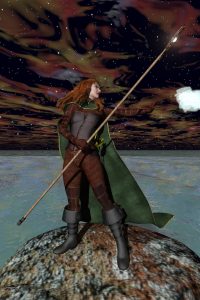
Now she had light – but although the new sun burned it only warmed her face and not her back. So she ripped out her hair and used it to weave a crumpled cloak. The work was painful and she wept as she wove, painting the fabric with her tears. When it was done, she pulled the cloak around her shoulders and curled up beneath its warmth, rocking herself back to sleep. The folds of the cloak became the mountains. The water from her tears became the rivers and the sea. From the tumbling drops of her blood, the moons were born, joining her in slumber, forever circling her body as she, too, circles the burning sun.
Back to the Index
Explore the Known Kingdoms
Overview
Known Kingdoms
The Wider World
Intelligent Species
Matters of Faith (Gods, Cults and Divine favours)
Matters of Magic
Landmarks and Landscapes
Beasts and Monsters
People of note
It is said that, on the first day, Val’vachea, earth mother, creator of life, womb of the world, woke to the cold and darkness of the void …
The Known Kingdoms
Maps
Political: 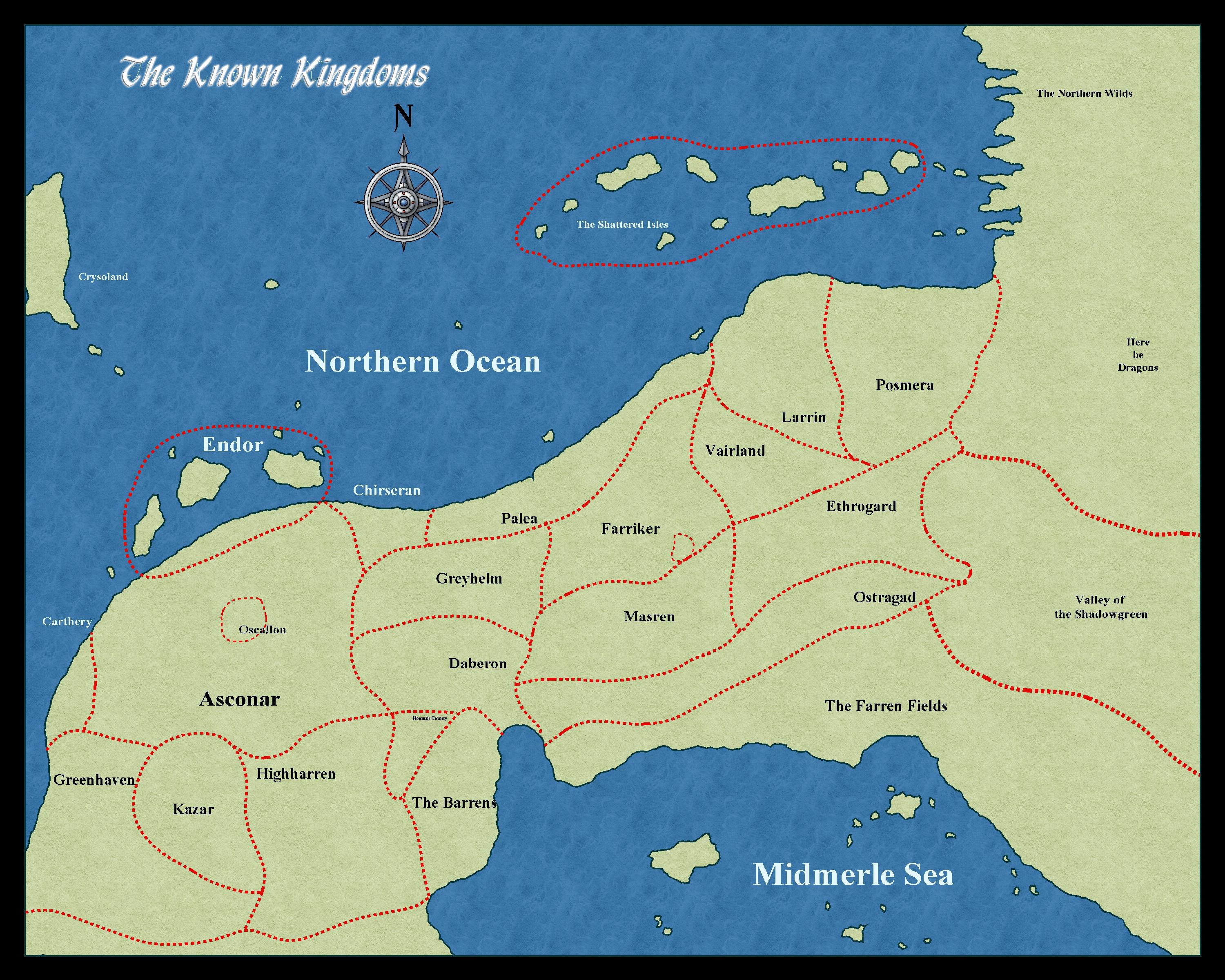
Geographical: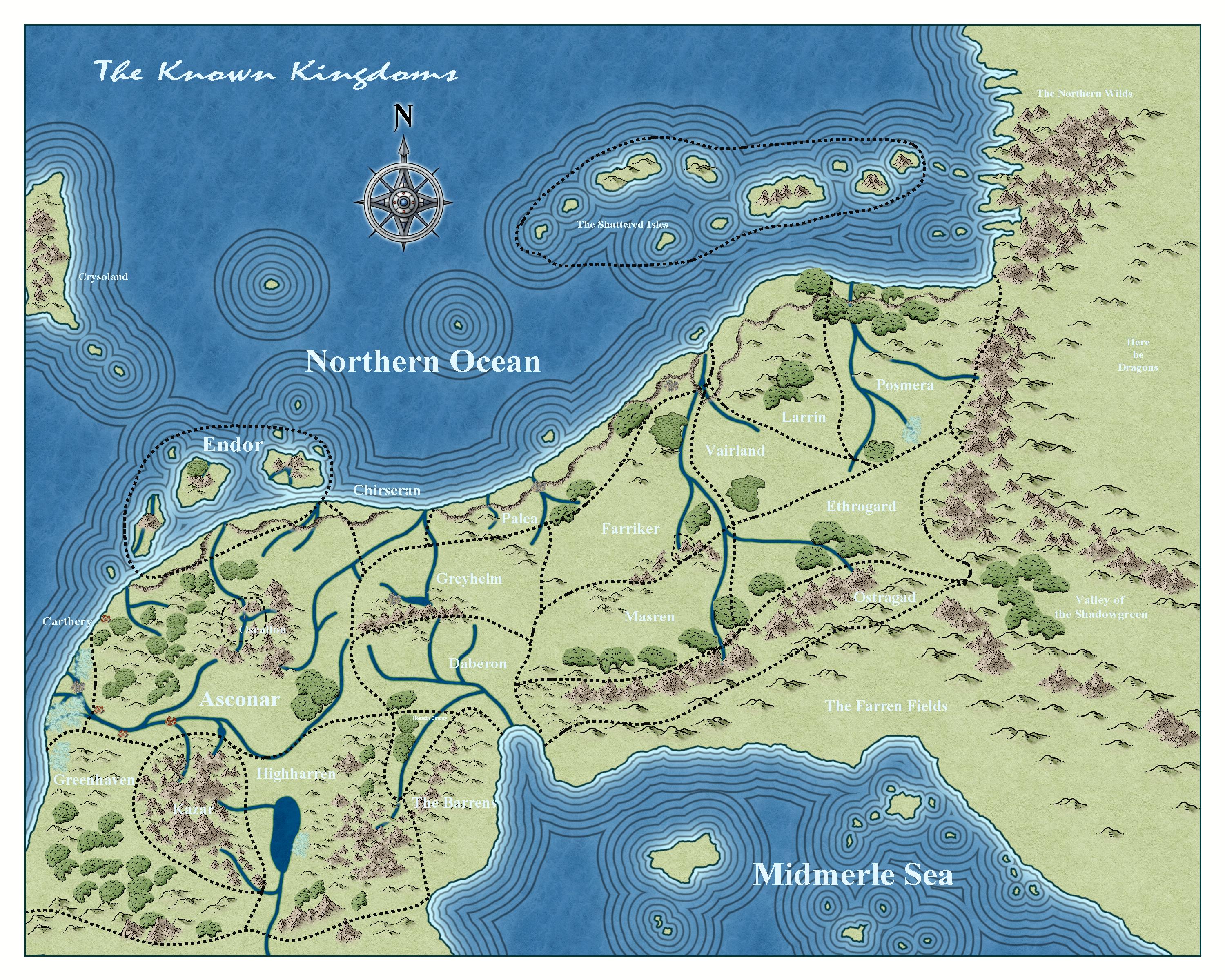
R’rruthren

The R’rruthren are a felinoid race – they have fur, tails, large motile ears, whiskers, and retractable claws on both hands and feet. They generally stand on two, rather than four feet, but can drop to all fours to achieve extra speed when on a hunt. Like all members of the cat family, they walk on their toes, having a high heel on their back legs and elongated palms connecting their fingers to their arms.
They are shorter than humans, with adult heights averaging around a metre and a half when standing in a relaxed pose. Fur colours tend to be dark, although paler variants can be found among northern prides, and markings range from stripes, through swirled and brindled coats, to single coloured coats. White, or light tips to tails, and digits are fairly common, as are paler flashes on stomachs and chests. Eyes can be green, gold, blue, or silver grey, with no white edges, and deeper colouration. Some R’rruthren develop odd coloured eyes – one green, one gold, for instance – and these are thought to be marked by their gods and able to call upon them for guidance and aid.
They can be found all across the Known Kingdoms, but their primary hunting grounds lie on either side of the Midmerle Sea, in the Farren Fields and the Jungles to the south. Prides also roam the the Northern Wilds, and the lands south of Greenhaven – both the in the mountain ranges and the deserts that lie beyond them.
R’rruthren are tribal by nature, preferring to live in family groups or prides, but coming together as larger groupings for festivals and co-operative projects. Many of these prides are nomadic, or semi-nomadic, moving with the wild herds that they hunt as the seasons change. Some raise and train luprrin – a form of domesticated large hunting cat, sleek as leopards and as swift as cheetahs. The less nomadic prides also keep kir’rritle – smaller, striped and spotted cats bred for their skills in hunting small prey such as rabbits, game brirds, and even fish. The interbreeding of kir’rrtile with domestic cats kept by humans has created the Kirtle Cat – a breed known to be remarkably smart, able to learn a few words, and to understand simple instructions. Kirtle cats are rare, and much prized in human settlements. R’rruthrens find them amusing and tend to keep them as pets rather than working hunters.
R’rruthrens love luxury, but are at home in the wilds as much as they are curled up in lavishly furnished tents, in cosy cover dwellings, or lazing by the fire in human homes and castles. They are hunters, and obligate carnivores, although many that live in human lands find other occupations and enjoy very varied diets. They can – and do – drink alcohol, but prefer fragrant wines and sweet ciders to coarse beers and ales. They have an acute sense of smell, and sensitive ears: they can also perceive a much wider range of sounds than human ears, being able to catch the squeak of bats on the wing and the faint flutter of both insect and flitter wings. They see well in the dark, but can struggle in bright light, their eyes better attuned to movement than minute details.
Their most unique feature, however, is literally having nine lives.
Every R’rruthren born will be born again another eight times, each time retaining the knowledge and experience they have gained in their previous life. The thren – the soul and spirit of each life – is drawn back to their original birthing pride to be reincarnated in a new body, and to grow again from kit to adult. This cycle can only be disrupted by the extinction of their family line, and even then, a displaced thren may find shelter in a distantly related pride. This gift – or perhaps curse – can lead to interesting encounters where a pride’s youngest kit may also be one of their elders. Contrary to what humans may think, the knowledge that they will be returned from death does not make them reckless, although the first-born may have less awareness of the value of each life than those further through the cycle.
They have a life-span of around forty to fifty years, but can live up to sixty or so in their final lives, given them an overall lifetime of between 350 to 500 years. That tends to give them more in common with Elfin, and with Dragons, than it does humankind – they live for the moment, but are aware of the longer cycles of time and the value of prudent foreplanning.
Because the prides know that their first-born will come back, they are encouraged to roam the world. Most – if not all – of the lone R’rruthren wanderers, the adventurers and explorers found far from their homelands – are first or second born. They experience everything they can, knowing they will eventually bring that knowledge and experience back to share with their families. These wanderers find work in human cities, take passage on ships serving as crew (or pirates), climb distant mountains, seek out ancient dragons, and talk to the spirits of earth, water, air and sky. Because this early wanderlust, human’s tend to view R’rruthrens with a level of suspicion, thinking they might be thieves (some are), or troublemakers (they like to live in ‘interesting’ times). Mostly they are just curious and eager to experience and learn – but they have wild nature, and may not always follow local rules and laws.

One thing is certain, though – despite appearances, they do value their lives and try very hard not to lose one if they can avoid it. If they can’t – well, they accept that as the Hunter’s will, and do not fear death, choosing to welcome it as something that will become familiar over time.
Should they come to that acceptance, only to find that their current life is spared due to some other being’s intervention, then they owe that being a life debt – and will – if possible, spend the rest of that life serving, protecting, and generally watching over their saviour.
TOC
Carthery
Capital: The city of Carthery
Medium of exchange: Gold Solars, Silver Cubes, Iron rings. (And any other currency if you are offering it – or even if there was no offer involved).
Carthery is ruled by a Duke, supposedly nominated by the local noble families, although succession and the selection process is probably a far cry from expectations of a ‘fair and free’ election.
Population is primarily Human in the city and surrounds areas. Elfin groves can be found on the borders with Greenhaven, and the swamps of the delta are home to several tribes of Sansig.
Primary exports: sparkweed, hemp (they make of lot of rope), perfumes and distilled oils (from plants growing in the delta). They also are a centre for naval trade, their port serving several large merchant fleets, which include importing (for on-going export) from Crysoland, The shattered Isles, the Northern raiders, and countries along the Northern coast. They particularly specialise in whale bone and walrus ivory, but send barges up river to Nemithia and Daberon beyond it, with cargoes of ambergris, sea coal, and any number of rarities that have passed through merchant trader hands.
The Kingdom of Carthery was once a part of Asconar. Although it is referred to as a Kingdom. it is better called a Dukedom, since it is the Duke who commands its destiny. Even back then it was a despised and much neglected part, despite being one of the country’s principle ports.
 It’s a marshy, hostile piece of land, primarily consisting of the Medlure Delta, over which the river crawls in a thousand channels, finally spilling into the sea in several places along the shallow coast.
The coast itself changes constantly, being scoured by the red tides and, after them, re-deposited with a mix of soils brought down the river and the sand and rock eroded from further along the Northern coast. The Medlure has long since carved a valley between the hills of the Forest Gleanings and the southern hills in Greenhaven: the Delta is a sink hole that attracts the debris and detritus that comes down the river and up with the tides – and that includes the dregs of humanity, which have claimed it for their own.
It is also home to several Sansig tribes, who still live their nomadic lives among the marshes and river channels that crisscross the delta. They work as ferrymen and hunters, serving and feeding the city that hunkers at the heart of the land like a fat, bloated spider.